 Sideshift
Sideshift fixed rates require the quoted deposit before the rate lock expires
Sideshift fixed rates lock an exchange quote for 15 minutes and require the exact quoted deposit before expiry. The displayed rate includes the network fees charged for the shift. Entering either the amount to send or the amount to receive determines the other amount. A wrong or late deposit can interrupt automatic processing and lead to review or a refund.
The deposit amount uses the coin you send; the settlement amount uses the coin you receive. Each quote also identifies the relevant networks. A locked exchange rate sets coin quantities, while their fiat market value can move.
The short version: A fixed-rate deposit of the wrong amount can be refunded automatically when its refund network fees are low and a refund address is available.
The chosen amount determines what the order expects
A fixed quote calculates one side of the exchange from a specified amount on the other side. That calculation turns the deposit quantity into an order requirement. The selected sending coin, receiving coin, and networks belong to that quote; changing them requires another quote.
Quotes based on the sending amount
Setting depositAmount establishes the quantity to send, and the quote returns the corresponding settleAmount. The settlement field describes the receiving quantity in its own coin. Keeping these fields distinct prevents a receiving quantity from being mistaken for the amount that must fund the order.
Quotes based on the receiving amount
Setting settleAmount asks for a particular receiving quantity. The returned depositAmount then specifies the deposit required for that payout. Preserve its decimal precision and include any depositMemo returned with the shift in the deposit transaction. Omitting a required deposit memo can lose the funds. Choosing the payout quantity still leaves an exact sending requirement, and the pair’s amount limits apply when requesting the quote.
Does the 15-minute lock include settlement time?
The 15-minute window limits the fixed quote’s deposit validity; it does not promise completed settlement within that period. In API v2, the lock starts when the quote is created. The returned expiresAt timestamp records its deadline. Blockchain confirmations and payout processing take additional time. A pending deposit means Sideshift has detected funds and awaits confirmation, with the rate locked. Broadcasting a transaction from a wallet alone does not establish timely detection by the exchange.
Network fees affect the rate for the entered amount
The displayed fixed exchange rate includes the network fees that Sideshift applies to the shift. Changing the entered amount can change that effective rate before order creation. The fee calculation concerns the specified exchange amount and selected pair.
The costs inside the exchange rate
The service’s sending fee concerns its payout transaction to your receiving address. Some deposits also incur a receiving fee for moving funds from the assigned deposit address into processing, known as a sweep. These charges depend on the selected coins and networks. The fee model also includes an address-creation charge for certain token deposits. Sideshift currently reuses those deposit contracts and does not charge that address fee. Including applicable charges in a fixed quote does not establish a universal fee percentage for every pair and amount.
The browser shows variable-rate network fees separately on the order page. Those charges need to be included when comparing the two rate modes.
The sending wallet and amount limits
The network fee for transferring funds from your sending wallet is a separate funding expense. The quoted deposit amount still needs to reach the assigned destination in full. A wallet setting that deducts its transaction fee from the entered transfer amount can therefore cause a mismatch, even when the displayed transfer amount initially matches the quote.
Minimum deposits change with coin prices, network fees, and processing costs. Sideshift sets maximum amounts, which can vary by coin. For fixed orders, the interface shows these limits while you enter the amount. Passing the quote-creation limits does not make the resulting fixed deposit flexible: automatic processing still expects the quoted amount.
Amount selection and refund destinations
The amount entered determines how the exchange calculates the quote. A saved refund address lets an eligible refund proceed without waiting for a destination. These settings can combine within a fixed order. Variable pricing provides a separate alternative when the sent amount needs flexibility and the selected network supports that mode.
| Supported choice | What it specifies | Processing and payout limits |
|---|---|---|
| Fixed quote based on the sending amount |
Supply depositAmount; the quote calculates the receiving amount.
|
A mismatched deposit can interrupt automatic processing. |
| Fixed quote based on the receiving amount |
Supply settleAmount; the quote calculates the required deposit.
|
The calculated deposit remains an exact requirement. |
| Variable-rate shift | The deposit may vary within the permitted range; pricing locks when the deposit is received. | The receiving amount can change before deposit receipt. |
| Fixed shift with a saved refund destination |
Provide refundAddress and any required refundMemo at creation.
|
High-fee or review cases can still delay a refund. |
| Fixed shift with a refund destination supplied later | The user or integration supplies the destination when a refund is needed. | The refund cannot progress until a destination is available. |
Refund handling depends on the deposit issue
Incorrect amounts can trigger refunds, although Sideshift may still settle small differences. It can refund an incorrect deposit automatically when the refund coin has low network fees and a refund address is available. High refund-network fees can leave the deposit rejected for human review. Late deposits can also require review, with settlement or refund depending on the outcome.
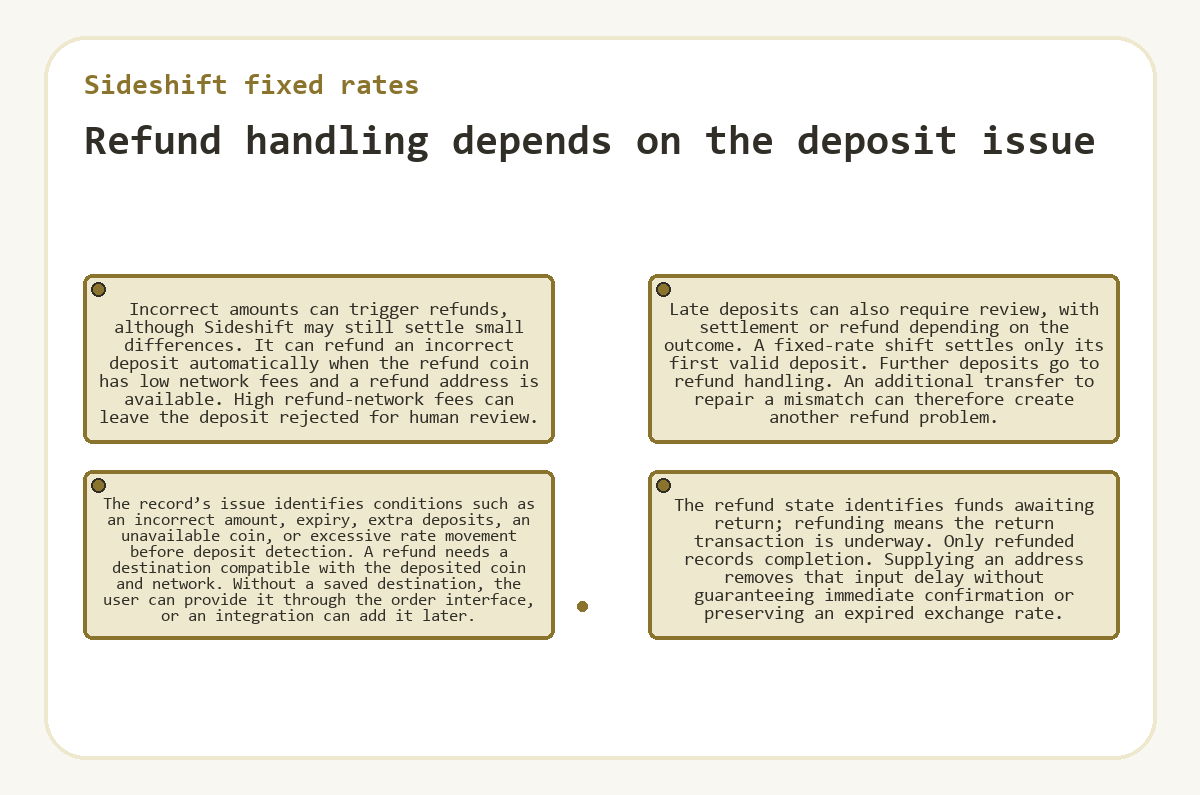
A fixed-rate shift settles only its first valid deposit.
Further deposits go to refund handling. An additional transfer to repair a mismatch can therefore create another refund problem. The record’s issue identifies conditions such as an incorrect amount, expiry, extra deposits, an unavailable coin, or excessive rate movement before deposit detection.
A refund needs a destination compatible with the deposited coin and network. Without a saved destination, the user can provide it through the order interface, or an integration can add it later. The refund state identifies funds awaiting return; refunding means the return transaction is underway. Only refunded records completion. Supplying an address removes that input delay without guaranteeing immediate confirmation or preserving an expired exchange rate.
Order states distinguish pricing from completed transfers
A quote records exchange amounts, while the order status records processing progress. Completion depends on the associated settlement or refund transaction.
Confirmation and settlement
The deposit needs the confirmations that apply to its coin before processing. Confirmation requirements and network congestion affect duration even when the deposit matches the quote. In the API, processing means Sideshift is handling a confirmed deposit, and settling means a payout transaction awaits confirmation. A quote response or shift identifier proves neither state. The receiving quantity in the quote describes the intended payout; the completed transaction establishes the actual transfer to the recorded destination.
The next quote after an interrupted order
The earlier order’s status remains relevant while its funds await review or refund. Any new fixed quote uses the selected pair, requested quantity, and prevailing fees, so its amounts can differ. The next rate-mode choice turns on the transfer amount: fixed pricing requires precision, while variable pricing allows amounts within the permitted range where supported.
Sideshift fixed rates FAQs
Why can a listed coin’s network reject fixed-rate quotes?
A supported network can be available only for variable-rate deposits or payouts. In API v2, depositVariableOnly and settleVariableOnly identify those direction-specific restrictions. A network listed in either relevant field cannot use the fixed-quote path for that direction. Deposit or payout availability can also be paused separately.
Does receiving a quote ID create a deposit address?
A quote ID identifies pricing; it does not create the fixed shift’s deposit destination. API v2 first returns a quote, then accepts its identifier as quoteId when creating the fixed shift. The shift response supplies the deposit address. The affiliateId must match across the quote and shift requests.
Why does a quote request fail when both amount fields are supplied?
The fixed-quote request accepts either depositAmount or settleAmount as its amount input. Supplying both produces a BAD_USER_INPUT error. Choose the sending quantity or the desired receiving quantity, and let the quote calculate the other side of the exchange.
Can I reuse an accepted quote for another fixed order?
An accepted quote cannot create another fixed shift. The API reports QUOTE_ALREADY_ACCEPTED when the quote has already been used. Another fixed order requires another quote, whose amounts and expiry can differ from the previous quote.
How can an API price preview reflect the eventual fixed quote?
A comparable preview uses the same pair, deposit amount, and commission setting as the quote request. Supplying the planned amount to the pair estimate makes its network-fee calculation relevant to that deposit. A preview does not reserve the rate, and market or fee changes can still alter the eventual quote.
When can I cancel an unused fixed order through the API?
The API permits cancellation after an order has existed for five minutes. Cancellation expires the order; requests made earlier, or for an already expired order, return BAD_USER_INPUT. This operation does not undo a blockchain transfer that has already been broadcast.
Can a fixed-rate payout include a receiving memo?
Yes, fixed-rate orders can include a settleMemo for receiving networks that require one. In API v2, networksWithMemo identifies the relevant networks. The memo accompanies the receiving address and helps the destination assign the payout to the intended recipient. Use the identifier that the receiving destination requires.
Is an expired fixed-order deposit address safe to reuse?
An expired fixed order’s deposit address should not be reused. Deposit addresses can later be unassigned and allocated to other shifts, so a saved address does not preserve the old quote or destination assignment. A fresh exchange should use the deposit destination returned for its new order.
Last updated: