 Sideshift
Sideshift lets svXAI holders withdraw XAI after staking rewards ended
Sideshift ended XAI staking rewards on 3 June 2026, while existing svXAI holdings remain redeemable for XAI through the unstaking interface. Redemption uses an Ethereum wallet and requires ETH for transaction fees. The withdrawal amount follows the vault’s share conversion, and previously distributed rewards remain part of users’ holdings.
Existing svXAI remains redeemable after staking rewards ended, and the wallet needs ETH to fund the withdrawal transaction.
Vault redemption and account withdrawals serve different balances
The unstaking interface exchanges svXAI vault shares for XAI, while account withdrawals handle XAI earnings that sit in a Sideshift account. A wallet holding svXAI has a claim on the staking vault’s underlying XAI. An account balance can contain earned commissions without representing vault shares. Choosing the relevant operation starts with identifying which balance actually holds the tokens.
For Sideshift’s unstaking interface, an account and a connected wallet are prerequisites. The paired wallet holds the shares for the standard withdrawal flow and receives the XAI after successful execution. Restoring a browser account alone does not move tokens from an Ethereum address.
Service eligibility also applies to XAI transactions. The end of staking rewards does not establish unrestricted access in prohibited jurisdictions.
svXAI shares determine the XAI redemption amount
Share amounts and underlying token amounts
svXAI represents shares in the vault, whereas XAI is the underlying token that a withdrawal returns. The two balances use different units. Earlier reward distributions added XAI to the vault, allowing the underlying value of shares to reflect accumulated rewards. An unchanged svXAI token count therefore did not mean that the holder had earned nothing.
The contract supports both share-based redemption and asset-based withdrawal. Its redeem operation specifies svXAI shares and returns the corresponding XAI. Its withdraw operation specifies an XAI amount and consumes the shares needed to supply it. These are contract capabilities; their presence does not mean that every website input offers both choices.
The preview and the amount actually received
A redemption preview estimates the XAI that the selected shares represent under the vault’s current conditions. The contract exposes previewRedeem for that purpose. That estimate differs from an XAI market price or an old yield percentage. Reading the preview through a normal blockchain query does not itself submit a withdrawal or spend the wallet’s shares.
The completed transaction establishes the actual token movement. A fiat-value display describes market valuation and does not establish how many XAI the vault returned.
Should I redeem svXAI now or wait?
Redeeming now converts the selected vault shares into wallet-held XAI; waiting retains those shares without earning further staking-program rewards. Compare the same svXAI quantity across the two choices. The reward cutoff is a dated program change, while the wallet’s gas estimate reflects conditions at the time of the proposed transaction.
If the gas estimate falls for the same redemption, its estimated ETH cost falls.
- Confirm that the connected Ethereum address holds the svXAI that you intend to redeem.
- Check the selected share amount and the XAI output preview using the same quantity for each timing choice.
- Compare the estimated transaction cost with the ETH available in that wallet before confirming.
- Reject an incorrect transaction request before submission; a completed redemption cannot be undone through a browser button.
- After submission, reconcile a successful receipt with the shares consumed, XAI received, and ETH fee charged.
A pending transaction leaves the withdrawal unresolved. Check its status before submitting another redemption request that could spend additional shares.
ETH covers the Ethereum transaction cost
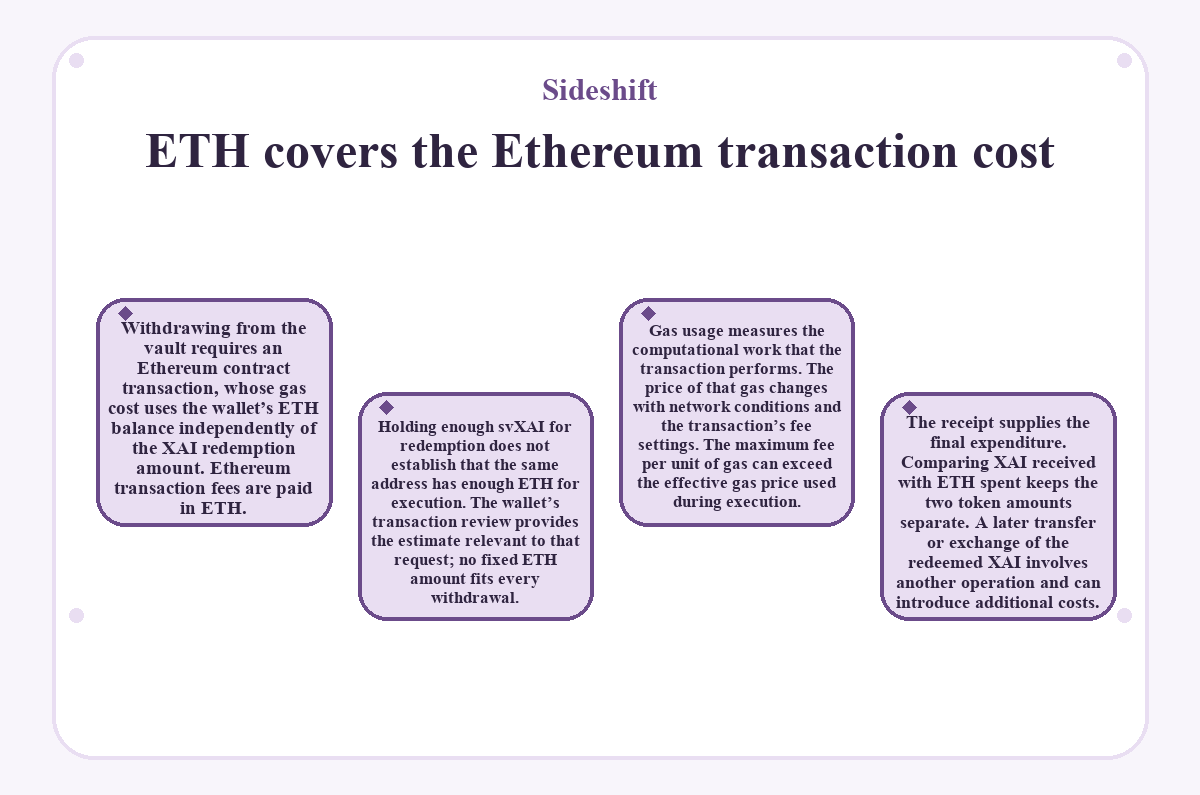
Withdrawing from the vault requires an Ethereum contract transaction, whose gas cost uses the wallet’s ETH balance independently of the XAI redemption amount. Ethereum transaction fees are paid in ETH. Holding enough svXAI for redemption does not establish that the same address has enough ETH for execution. The wallet’s transaction review provides the estimate relevant to that request; no fixed ETH amount fits every withdrawal.
Gas usage measures the computational work that the transaction performs. The price of that gas changes with network conditions and the transaction’s fee settings. The maximum fee per unit of gas can exceed the effective gas price used during execution. The receipt supplies the final expenditure. Comparing XAI received with ETH spent keeps the two token amounts separate. A later transfer or exchange of the redeemed XAI involves another operation and can introduce additional costs.
Account access and wallet authority remain separate
The browser account provides access to account information, while the Ethereum wallet authorizes transactions involving its vault shares. An account has an Account ID and an account private key that restores access on another browser or device. The wallet has its own signing credentials. Confusing these credentials can leave the account visible while the address holding svXAI remains unavailable for signing. Selecting a different connected address exposes a different on-chain balance, even when the browser account stays the same.
Wallet connection identifies an address to the interface. A transaction confirmation authorizes a specific contract action with its own parameters. Neither action requires pasting the wallet’s recovery phrase into the website. Account restoration uses the account credential in its restoration field; wallet recovery belongs within the wallet’s recovery process. The website withdrawal flow requires account access and the wallet’s signing authority.
Pending and failed withdrawals require different responses
A rejected wallet request
Rejecting an unsigned transaction request leaves the proposed withdrawal unsubmitted. The wallet’s tokens remain unchanged by that request, and no Ethereum execution fee arises.
This differs from trying to cancel after submission. A request that never reached the network has no pending blockchain transaction to replace.
A transaction waiting for inclusion
A pending transaction has reached a stage where network inclusion remains outstanding, so its identifier does not establish a completed withdrawal. Fee settings and earlier pending transactions from the same address can affect progress. Some wallets offer replacement or cancellation controls for pending transactions. These controls depend on the transaction’s state and can involve another network fee; they cannot reverse a redemption that has already completed.
A transaction that reverted
A reverted transaction records failed contract execution and leaves its attempted vault changes unapplied. Gas consumption can still reduce the ETH balance. Insufficient gas during execution is one possible cause; the transaction record may identify a different contract failure. Repeated submission without resolving the actual cause can spend more ETH while returning no XAI.
An ETH charge alongside an unchanged svXAI balance is therefore compatible with a reverted transaction.
Receipt records distinguish estimates from completed withdrawals
The withdrawal receipt and token movements establish what the vault executed, including the XAI recipient and the share amount consumed. A success status describes execution in the recorded block. The vault’s Withdraw event distinguishes the caller, share owner, and token recipient; these roles need not be interchangeable at contract level. The standard website flow sends the withdrawn XAI to the paired wallet, so the relevant recipient address matters when interpreting its result.
Balance changes alone can be ambiguous if the same address also made other transfers. A transaction-specific record ties the consumed shares and outgoing XAI to the relevant withdrawal. Its ETH fee measures execution cost independently.
Old staking rates describe a program that ended
XAI staking rewards ended on 3 June 2026. Historic annual percentage yields described earlier reward distributions and do not establish future income from retaining svXAI. Previously distributed rewards and staked XAI remained users’ holdings when the program ended. The closure changed future reward accrual without turning an old yield display into a withdrawal quote. The live share conversion answers the redemption-amount question, while Ethereum processing determines when a submitted withdrawal executes.
Redeemed XAI opens a separate holding or exchange decision
The vault withdrawal returns XAI to the paired wallet and leaves any decision to hold or exchange it outside the redemption itself. Wallet-held XAI remains a token position with a changing market valuation. Ending staking rewards did not convert it into cash or guarantee an exchange value. svXAI redemption determines the underlying token amount; a subsequent exchange determines the asset and amount that a different transaction would deliver.
A fixed-rate quote and a variable-rate quote concern that later exchange, rather than the vault’s share conversion. Their pricing conditions do not redefine the number of shares consumed in unstaking. Keeping XAI requires no immediate exchange order. Exchanging it calls for a separate choice of receiving asset, compatible destination network, and live quote, with the applicable transaction costs included in that decision.
Sideshift: reader questions
How can I identify the correct XAI token after unstaking?
The redeemed asset is SideShift Token, an ERC-20 token on Ethereum mainnet. Its token contract is 0x35e78b3982e87ecfd5b3f3265b601c046cdbe232. That contract identifies the underlying XAI token; svXAI has a separate vault-token contract. A matching symbol or logo alone does not establish that another token is the asset returned by this vault.
Why does my wallet hide XAI after a successful redemption?
A wallet can omit a token from its display even when the address holds it. Check the transaction’s XAI transfer and recipient address before treating an absent token entry as a failed redemption. A wallet that supports custom token imports can display XAI using its Ethereum token contract. Adding that display entry does not move or redeem tokens.
Can I use a wallet other than MetaMask to unstake svXAI?
Another wallet can work if the unstaking interface supports its connection and it controls the Ethereum address holding svXAI. The withdrawal process uses the paired wallet for transaction confirmation. Installing a different wallet application does not transfer the shares or establish control of their address. The relevant requirements are supported connection, signing authority, and ETH for execution.
Will XAI referral earnings stop because staking rewards ended?
The staking closure concerned vault rewards, while XAI referral commissions remain a separate incentive mechanism. Referral earnings arise from qualifying referred exchanges rather than simply holding svXAI. Accrued account earnings and vault shares therefore follow different withdrawal paths. Keeping shares after the cutoff does not generate staking-program rewards from subsequent exchange activity.
Is automatic withdrawal available for XAI account earnings?
Automatic payouts are available for accrued commissions through a configured payout arrangement. The commission system supports conversion into a chosen supported asset and payment to a designated wallet when the configured threshold is reached. That arrangement applies to account commissions. It does not automatically redeem svXAI held in an Ethereum wallet or eliminate gas requirements for a vault withdrawal.
Did the June 2026 burn proposal cover XAI that users had already withdrawn?
The June 2026 burn proposal covered undistributed staking-reward reserves, leaving users’ already distributed XAI outside its stated scope. The closure also preserved ownership of staked XAI. Burning that reserve concerns tokens set aside for future distributions, while a redeemed balance contains XAI that the vault has already returned to its holder.
Are XAI withdrawals available to United States residents?
United States residents are not permitted to transact in XAI through Sideshift. The restriction also covers users located, incorporated, or otherwise established there. Ending staking rewards does not create a general access exemption. Other prohibited jurisdictions also face restrictions, so possession of vault shares and technical wallet capability do not establish eligibility to use the service.
Last updated: